


Click Image for BBB Accredited Listing
Crisis Prevention and Intervention Training® (CPIT) is a registered trademark and exclusively owned by the Crisis Consultant Group, LLC.
Licensed and Insured Since 2004
2025 - All rights reserved.
2025 - All rights reserved.
STEP 1
BILLLING INFO:
*ENTER BILLING COUNTRY:
STEP 2
PARTICIPANT INFO:
*Prices Shown Are USD*
| Item | PRICE: |
|---|---|
| $139.95 |
STEP 3
ADD CEU'S (IF NEEDED):
KK Educational Services, Inc: FL BON Provider #50-1163 / CA BON Provider #13594
*Prices Shown Are USD*
| Item | ORDER TOTALS: |
|---|---|
| Dynamically Updated | $XX.00 |
STEP 4
CLICK TO PURCHASE:


Processed by Stripe, Inc.®
TERMS & CONDITIONS:
-ONLINE COURSE ACCESS PROVIDED FOR 30-DAYS
-PURCHASES ARE NON-REFUNDABLE. STORE CREDIT OFFERED FOR UNUSED LICENSES ON CASE-BY-CASE BASIS


-Department of Justice (DOJ)
-And Others


Utilized Across the USA, Canada and Internationally Since 2004
- DISCOUNT OFFER: Non-Violent Physical Crisis Intervention
-
DISCOUNT OFFER: Second Year Re-Certification
- Precursors to Crisis
- Motivating Disagreeable Persons In Crisis
- The Crisis Cycle (Emotional Response Levels)
- Handling Passive Non-Compliance
-
Non-violent Intervention
- Professional Distancing
-
Building Rapport
- Trauma Informed Care
- Implicit Bias
Just A Few Of Our Satisfied Clients

Across the USA & Internationally Since 2004


THIS TRAINING IS UTILIZED BY:
- MENTAL HEALTH WORKERS
- TEACHERS & PARA-PROFESSIONALS
-
HEALTHCARE & RN'S, LPN'S, CNA'S
-
GROUP HOME STAFF
-
PRN AGENCY STAFFING
VERIFIED STUDENT TESTIMONIAL
Katina Davis
VERIFIED STUDENT TESTIMONIAL
VERIFIED STUDENT REVIEWS


Crisis Prevention and Intervention Training® (CPIT) is a registered trademark and exclusively owned by the Crisis Consultant Group, LLC. 2024 - All rights reserved.
8005 - C #710 Creighton Parkway, Mechanicsville VA 23111
"A+" BBB Rating - (HERE)
Licensed and Insured Since 2004
Questions or Concerns? Email: training@crisisconsultantgroup.com
8005 - C #710 Creighton Parkway, Mechanicsville VA 23111
"A+" BBB Rating - (HERE)
Licensed and Insured Since 2004
Questions or Concerns? Email: training@crisisconsultantgroup.com
TAGS:Crisis,Training,Intervention
Crisis Prevention Intervention Training Online
Crisis Prevention Course, Crisis Prevention Class, Crisis Intervention Skills, Crisis Intervention Services, Crisis Management Training, Crisis Response Training, Crisis Prevention Team, Crisis Hotline, Mental Health Crisis, Behavioral Health Crisis, Nonviolent Crisis Intervention, Non-Violent Crisis Intervention, Nonviolent Intervention Certification, Training, Certification, Certification Online, Techniques, Strategies, Training Programs, Training Options, Training Courses, Online Courses, Instructor, Instructors, Certified Instructors, Certified Instructor, Risk Assessments, Behavioral Risk,
Competency Management, Successful Course Completion, Certification Programs, Certification Exam, Professional Credentials, Renewal Process, Training And Development, Evidence-Based Training, Best Practices, Practical Components, Physical Skills, Real-World Experiences, Case Studies, Crisis Management Curriculum, Management Courses, Verbal De-Escalation Strategies, Violence In The Workplace, Work Violence, Safety Training, General Safety Measures, Emergency Preparedness, Emergency Management, Emergencies, Emergency Room, Mental Health Services, Healthcare Settings.
Crisis Intervention Training Online
Crisis Intervention Prevention
Therapeutic Relationship, Challenging Behaviors, Disruptive Behavior, Disruptive Behaviors, Assaultive Behavior, Behavior Analysis, Behavior Management, Physical Intervention, Physical Interventions, Physical Restraint, Physical Maneuvers, Restrictive Interventions, Restraint, Decision Making, Workplace Culture, Employee Engagement, Federal Regulations, behavior therapy, therapy, public safety, management skills.
Crisis Intervention
Crisis Prevention Institute Certification
Crisis Intervention Training Certification
Crisis Intervention Certification Online
Online Crisis Intervention Training
Healthcare Services, Healthcare Providers, Healthcare Professionals, Allied Health Professionals, Mental Health Professionals, Nurse Training, Nursing Professionals, Staff Training, Staff Skills, Social Workers, Healthcare Facilities, Outpatient Care, Community Health, Community Health Centers, Special Education, Patient Experience, Patient Outcomes, Positive Patient Outcomes, Traumatic Stress, Traumatic Experiences, Psychological Trauma, Trauma-Informed Approaches, Coping, Coping Skills, Coping Strategies, Anxiety, Resilience.
Crisis Intervention Online Training
Crisis Intervention Certificate Online
Crisis Intervention And Prevention
Crisis Intervention Prevention Training
Crisis Training
Crisis Prevention Intervention Training & Certification Online
When a person begins moving toward a crisis, the response they receive can influence what happens next. Recognizing changes in behavior, communicating effectively, understanding escalation, and knowing when to change an approach are practical skills for professionals who regularly deal with difficult or unpredictable situations.
Crisis Prevention Intervention
Crisis Prevention Intervention starts before a situation reaches its most serious stage. A person may become anxious, frustrated, resistant, withdrawn, verbally disruptive, or increasingly agitated before behavior becomes dangerous. Recognizing those changes creates opportunities to intervene earlier, when communication, rapport, and de-escalation may have the greatest effect.
This requires more than memorizing a response to use during an emergency. Professionals need to observe behavior, consider what is happening around the person, assess changing levels of risk, and recognize how their own communication may affect the interaction. The appropriate intervention can change as the crisis develops.
What Is Crisis Prevention Intervention?
Crisis prevention and intervention connects early recognition with an appropriate response. Prevention focuses on identifying behaviors and circumstances that may indicate a developing problem. Intervention begins when a professional uses that information to decide how to communicate, establish rapport, reduce escalation, or respond to an increasing level of risk.
That distinction matters because not every difficult interaction is at the same stage. Passive non-compliance, emotional distress, verbal agitation, aggressive behavior, and an immediate safety threat present very different circumstances. Effective crisis management depends on recognizing those differences rather than applying the same response to every person.
Early Warning Signs And Crisis Prevention
Changes in speech, body language, emotional responses, cooperation, movement, or interaction with others can provide important information about a developing crisis. Some changes are subtle; others are obvious. Staff who recognize early warning signs have more time to understand what is occurring and choose an appropriate intervention strategy.
Early intervention can also prevent professionals from unintentionally contributing to escalation. Pushing too hard, communicating poorly, entering a person's space unnecessarily, or turning a disagreement into a power struggle can make an already difficult situation worse. Awareness gives the responder an opportunity to change course.
Risk Assessment And Situational Awareness
A developing crisis rarely presents just one piece of information. The person's behavior, level of agitation, surroundings, communication, available support, and potential for harm all contribute to the overall situation. Staff need to be able to read those conditions together and recognize when risk is changing.
Situational awareness also means continuing to assess rather than making one judgment and assuming it will remain accurate. A response that works early in an interaction may become ineffective as circumstances change. Recognizing that shift is an important part of deciding what to do next.
Crisis Prevention Training
Crisis Prevention Training gives professionals a framework for understanding how crises develop and how their response can affect the outcome. The goal is to build usable skills in observation, communication, intervention, de-escalation, risk awareness, and crisis response rather than simply teaching terminology.
CPIT addresses precursors to crisis, motivating disagreeable persons in crisis, the crisis cycle and emotional response levels, passive non-compliance, nonviolent intervention, professional distancing, building rapport, trauma-informed care, and implicit bias. Together, these concepts help participants look at crisis behavior as a process instead of an isolated event.
Crisis Prevention Skills And Intervention Strategies
A skilled response begins with understanding what the behavior may be communicating and what level of intervention the situation requires. Sometimes that means listening and allowing a person time to regain control. In another situation, the responder may need to establish clearer boundaries, modify the environment, seek assistance, or move toward a different level of response.
Professional distancing is important here as well. Crisis situations can become personal very quickly if a responder reacts emotionally to anger, insults, resistance, or challenging behavior. Maintaining professional control makes it easier to think critically and select an intervention based on the situation rather than the responder's own frustration.
Crisis Communication And Communication Skills
What is said during a crisis matters, but so does how it is said. Tone, pacing, body language, physical positioning, active listening, and nonverbal communication can reinforce a message or undermine it. A calm statement delivered in a confrontational manner may not be experienced as calm at all.
Communication also needs to reflect the person's current emotional state. Someone experiencing significant distress may have difficulty processing complicated instructions or responding to rapid questioning. Clear language, reasonable expectations, active listening, and an effort to establish rapport can make communication more productive.
Evidence-Based De-Escalation Techniques
De-escalation is not one scripted phrase that works on everyone. It is a collection of communication and behavioral strategies selected according to the person, the environment, the behavior being displayed, and the level of risk.
Useful approaches may include active listening, reducing unnecessary confrontation, maintaining appropriate personal space, identifying the person's concerns, setting reasonable expectations, offering choices when appropriate, and remaining professionally composed. The responder then watches what happens. If tension decreases, the approach may be working. If behavior continues to escalate, the response may need to change.
Crisis Prevention Intervention Training
Crisis Prevention Intervention Training brings prevention and response together. Professionals learn to recognize precursors to crisis, understand behavioral and emotional escalation, communicate more effectively, and select interventions that correspond to what is actually happening.
That makes self-awareness an important part of the training. A responder brings his or her own stress, assumptions, communication style, and emotional reactions into an interaction. Recognizing those factors can help prevent a professional from escalating a situation that might otherwise have remained manageable.
De-Escalation Training And Crisis Response
De-escalation is especially valuable while a person is still able to engage with the responder. Building rapport, listening, communicating clearly, and avoiding unnecessary confrontation may help reduce tension before the situation progresses.
But crisis response also requires recognizing when something is not working. Staff should be prepared to reassess the situation, recognize an increasing level of risk, and respond within their training, responsibilities, and organizational procedures. Good crisis response is adaptive rather than automatic.
Verbal De-Escalation Techniques
Words can either create room for cooperation or increase resistance. Questions that help clarify a person's concerns, statements that demonstrate listening, clear explanations, and reasonable choices can make an interaction easier to manage. Arguing simply to prove a point usually does the opposite.
Verbal techniques work alongside nonverbal behavior. Facial expression, tone of voice, physical distance, posture, and movement are all part of the communication taking place. Professionals need to be aware of both sides of that exchange.
Managing Challenging, Disruptive And Aggressive Behavior
Challenging behavior exists on a spectrum. A person refusing to cooperate is not necessarily presenting the same risk as someone making threats or attempting physical aggression. Treating those situations as though they were identical can lead to an inappropriate response.
Understanding escalation helps staff distinguish among levels of behavior and respond accordingly. It also helps professionals recognize when communication and de-escalation remain appropriate and when the situation requires additional safety measures or assistance.
Managing Potentially Harmful Situations
Potentially harmful situations require attention to both the individual and the environment. Staff may need to consider proximity to other people, available assistance, possible hazards, changes in behavior, and whether the current intervention is increasing or decreasing risk.
No training can eliminate every dangerous situation. What training can provide is a more organized way to recognize risk, make decisions, and respond within the professional's role and established workplace procedures.
Crisis Prevention And Intervention Training
Crisis Prevention And Intervention Training develops both sides of effective crisis response: recognizing problems early enough to prevent unnecessary escalation and knowing how to respond when a crisis is already developing. Those skills are connected. Better recognition creates more opportunities for effective intervention.
The crisis cycle provides a useful way to understand that progression. Behavior and emotional responses can change over the course of an incident, and the most appropriate professional response may change with them. Training helps participants recognize those transitions rather than viewing the entire event as one continuous state.
Early Intervention And Crisis Response
Earlier intervention generally gives a responder more options. A person who is beginning to show frustration or distress may still be highly responsive to listening, rapport, environmental changes, reassurance, or other communication strategies.
As behavior changes, staff need to continue observing rather than assuming the original approach will remain effective. This connection between early intervention and ongoing assessment is one of the reasons situational awareness is so important during crisis response.
Conflict Management And Conflict Resolution
Not every conflict has to become a crisis. Disagreements, frustration, resistance, and misunderstandings occur routinely in workplaces and care environments. The way those moments are handled can determine whether tension settles or continues to build.
Listening carefully, avoiding unnecessary power struggles, clarifying expectations, acknowledging legitimate concerns, and looking for workable solutions can help professionals manage conflict while maintaining appropriate boundaries. These are useful skills even when an interaction never reaches the level of a behavioral crisis.
Trauma-Informed Care During Crisis Intervention
A professional may know very little about the experiences that shaped the person standing in front of them. Previous trauma can influence perceptions of authority, personal space, physical contact, loss of control, confrontation, and other elements of a crisis interaction.
A trauma-informed approach asks responders to consider those possibilities without assuming they know someone's history. Respectful communication, awareness of how interventions may be perceived, appropriate boundaries, and efforts to avoid unnecessary escalation can support a more thoughtful response. Trauma-informed care is included in the CPIT curriculum along with professional distancing, rapport building, and nonviolent intervention.
Workplace Violence Prevention And Personal Safety
Workplace violence is not limited to a single profession. Healthcare workers, educators, human service staff, law enforcement personnel, correctional staff, security professionals, retail employees, and many others can encounter threatening or aggressive behavior.
Prevention begins well before a physical incident. Recognizing warning signs, communicating concerns, assessing risk, understanding escalation, and knowing the organization's procedures can all contribute to a safer workplace. Crisis training gives employees a shared framework for thinking and communicating about those situations.
Crisis Prevention Intervention Training Online
Crisis Prevention Intervention Training Online allows professionals to develop crisis prevention, communication, intervention, and de-escalation skills without attending a scheduled classroom course. Crisis Consultant Group's CPIT program takes approximately 3.5 hours to complete and provides 30 days of online access, allowing participants to progress through the material at their own pace.
The online format is particularly practical for working professionals who cannot easily coordinate travel or a fixed classroom date. It can also make training easier to access when employees work different shifts or are spread across different locations.
Crisis Prevention And Intervention Training Online
Crisis Prevention And Intervention Training Online combines flexible course access with instruction in the progression of a crisis. Participants study prevention, behavioral and emotional response levels, communication, professional distancing, rapport, nonviolent intervention, trauma-informed care, and other concepts that influence crisis response.
The purpose of putting the material online is not to reduce it to a collection of tips. The concepts need to connect. Warning signs influence risk assessment; risk influences intervention; communication can affect escalation; and the person's response tells the professional whether the approach is helping or whether the situation needs to be reassessed.
Crisis Prevention Training Online
Crisis Prevention Training Online gives individuals greater control over when they complete their training. CPIT is available for 30 days after access is provided, and the approximately 3.5 hours of course material can be completed at the participant's own pace.
That flexibility can be useful for nurses, healthcare workers, behavioral health professionals, educators, direct support professionals, agency staff, and others whose schedules make a traditional classroom session inconvenient.
Online Crisis Prevention Training
An effective online course still needs to build understanding from one concept to the next. Participants should come away seeing the relationship between behavior, emotional response, communication, professional boundaries, escalation, intervention, and safety—not simply remembering a series of definitions.
CPIT also includes a downloadable handbook so participants have supporting material to accompany the online training.
Flexible Online Crisis Prevention Training
Self-paced access can be particularly useful when an organization has employees working different schedules. Instead of bringing everyone into one classroom at the same time, participants can complete the course during the 30-day access period.
For individual professionals, the same flexibility makes it possible to fit training around work and other responsibilities while still completing a structured crisis prevention and intervention program.
Interactive Online Learning And Practical Skills
The value of crisis training ultimately depends on whether participants understand how the concepts relate to situations they may actually encounter. A professional needs to be able to recognize behavior, think about what may be driving it, evaluate risk, communicate appropriately, and make a reasoned decision about what to do next.
Those relationships are more important than memorizing isolated terminology. The objective is to develop a framework participants can carry back into their own professional environments.
Crisis Prevention Intervention Certification
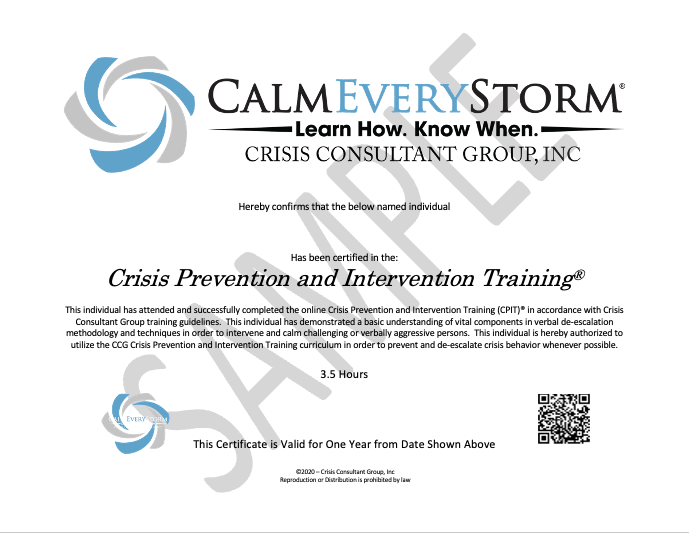
Crisis Prevention Intervention Certification is awarded after successful completion of Crisis Consultant Group's CPIT course. The certification documents completion of the Crisis Prevention and Intervention Training® program and is valid for one year.
Because training requirements differ among employers, professions, facilities, agencies, and jurisdictions, participants should confirm the requirements that apply to their particular position. CPIT is a crisis prevention and intervention certification program; it should not be represented as a separate professional license or occupation-specific credential.
Crisis Prevention Certification
Crisis Prevention Certification provides documentation that a participant has completed training in the concepts covered by CPIT, including crisis prevention, intervention, communication, behavioral escalation, professional distancing, rapport, trauma-informed care, and nonviolent intervention.
Organizations may use crisis prevention training as part of broader staff development, workplace safety, or behavioral response programs. The exact requirements and standards that apply should always be determined by the employer or appropriate professional or regulatory authority.
Crisis Prevention Intervention Certificate
Crisis Prevention Intervention Certificate is another phrase professionals use when looking for documentation of completed crisis training. Participants who successfully complete CPIT receive certification that remains valid for one year.
The distinction between a course certificate or certification and a professional license is important. Requirements can vary substantially among occupations and organizations, so participants should verify what their employer or profession specifically requires.
Certification Requirements And Course Completion
CPIT takes approximately 3.5 hours to complete and provides participants with 30 days of online course access. A downloadable handbook is included, and certification is provided after successful completion of the training.
The course is designed to make completion practical for working professionals while still providing a structured curriculum covering the progression from crisis prevention through intervention and response.
Professional Development And Continuing Education
For nurses who need continuing education, an optional 3.5 RN continuing education hours component is available through KK Educational Services for an additional $24. This is separate from the standard CPIT course purchase.
Other professionals should determine whether the course or certification meets continuing education, professional development, employer, or regulatory requirements applicable to their own role.
Crisis Prevention Intervention Certification Online
Crisis Prevention Intervention Certification Online gives professionals a way to complete the CPIT program and earn certification without attending an in-person class. Participants receive 30 days of online access, complete approximately 3.5 hours of training at their own pace, and receive certification after successful completion.
For people balancing work schedules, different shifts, or geographic distance, that removes many of the practical barriers associated with attending training at a fixed time and location.
Crisis Prevention Certification Online
Crisis Prevention Certification Online combines the flexibility of an online course with documented completion of crisis prevention and intervention training. The CPIT curriculum covers the development of crisis behavior along with communication, intervention, de-escalation, professional distancing, rapport, trauma-informed care, and related response concepts.
The certification is valid for one year. Participants can then determine their future training or renewal needs according to their employer, profession, or organization.
Online Crisis Prevention Certification
Completing certification online can be useful for both individual professionals and organizations that need a more flexible training option. Employees do not have to be in the same location or working the same schedule to complete the course.
That accessibility is especially useful in fields where staffing and scheduling can make classroom training difficult, while the structured course still gives participants a common foundation in crisis prevention and intervention.
Online Course Completion And Certification
Participants work through the CPIT curriculum during their online access period and receive certification after successful completion. The downloadable handbook provides additional material that accompanies the course.
Certification is valid for one year, giving participants a clear completion period while allowing employers and professionals to determine when additional or renewed training is appropriate for their particular requirements.
Flexible Online Certification
Flexibility matters when training has to fit around real work schedules. A nurse working nights, a direct support professional working rotating shifts, or an employee in another location may not be able to attend the same classroom session as everyone else.
The online CPIT format removes that scheduling requirement while allowing participants to complete the training during the 30-day access period.
Crisis Prevention Intervention For Healthcare And Human Services
Healthcare and human service professionals often work with people experiencing pain, fear, frustration, mental health concerns, developmental disabilities, confusion, emotional distress, or other circumstances that can affect behavior. These environments make communication, observation, professional boundaries, and situational awareness particularly important.
The same underlying crisis skills can be applied differently according to the professional role and setting. A nurse, teacher, direct support professional, correctional officer, or security employee does not have identical responsibilities, but each may benefit from recognizing escalation and understanding how communication can influence an interaction.
Healthcare And Behavioral Health Professionals
Nurses, healthcare workers, clinicians, caregivers, and behavioral health professionals may encounter challenging behavior in hospitals, nursing facilities, outpatient programs, residential settings, and community-based care. In these environments, the responder often has to balance the immediate interaction with patient safety, staff safety, professional responsibilities, and the needs of other people nearby.
Recognizing distress early and responding appropriately can provide more options before behavior reaches a higher level of escalation.
Direct Support Professionals And Support Staff
Direct support professionals and other support staff frequently build long-term working relationships with the people they serve. That familiarity can help them notice changes in behavior, communication, mood, or routine that another person might miss.
Training can help staff connect those observations with crisis prevention strategies while maintaining professional boundaries and responding consistently when challenging behavior occurs.
Law Enforcement, First Responders And Correctional Facilities
Law enforcement officers, first responders, and correctional personnel may encounter crisis behavior under particularly stressful circumstances. Situational awareness, communication, risk assessment, and professional control can become critical when decisions need to be made quickly.
CPIT does not replace agency procedures, use-of-force training, legal requirements, or other occupation-specific instruction. Crisis prevention education can complement those systems by strengthening understanding of behavioral escalation, communication, and de-escalation.
Crisis Prevention, De-Escalation And Safe Crisis Response
Prevention, de-escalation, and response are most useful when they are understood as connected parts of the same process. Prevention creates opportunities to act early. De-escalation provides options for reducing tension and improving communication. Crisis response becomes increasingly important when behavior or risk continues to escalate.
Professionals who understand those relationships have more than one tool available to them. They can observe, communicate, reassess, adapt, and recognize when a situation requires a different response.
Building Communication And De-Escalation Skills
These skills improve through an understanding of both the person in crisis and the professional's own behavior. Listening, rapport, tone, personal space, body language, professional distancing, and clear communication all affect an interaction.
Self-awareness matters because crisis situations can be stressful for the responder as well. Remaining composed enough to think rather than react can make it easier to recognize what is changing and choose an appropriate next step.
Responding To Aggressive And Violent Behavior
As behavior becomes aggressive, assaultive, or violent, the level of risk changes. Communication may remain important, but personal safety, the safety of others, available assistance, and established organizational procedures become increasingly significant.
Professionals should respond within the boundaries of their training, authority, workplace policies, and applicable requirements. The purpose of understanding escalation is partly to recognize when the situation has moved beyond the response that was appropriate only moments earlier.
Supporting Safer Workplaces And Better Outcomes
A strong crisis prevention program gives staff a shared way to recognize and discuss difficult behavior before, during, and after an incident. Warning signs, escalation, risk, communication, de-escalation, and response become concepts the team understands rather than decisions being made from scratch every time something happens.
Those skills can be useful across healthcare, behavioral health, education, human services, childcare, corrections, law enforcement, corporate environments, retail, banking, sales, and security—anywhere professionals may need to navigate difficult interactions while maintaining safety and professionalism.
Training in Crisis Prevention Intervention
Crisis Prevention Intervention searches can reflect a broader search for training that teaches professionals how to recognize and respond to developing crisis situations. Crisis Consultant Group's program is CPIT and should not be confused with a certification or training program offered by another organization.
Crisis Prevention Intervention
Crisis Prevention Intervention is another search formulation people may use when looking for this type of training. CPIT is Crisis Consultant Group's Crisis Prevention and Intervention Training® program and covers prevention, communication, de-escalation, professional distancing, rapport building, trauma-informed care, and crisis response.
Crisis Prevention And Intervention
Crisis Prevention And Intervention connects recognition with response. Warning signs, situational awareness, communication, rapport, risk assessment, and de-escalation give professionals information and options as a situation develops rather than waiting until a crisis has reached its highest level.
Crisis Prevention And Intervention Certification
Crisis Prevention And Intervention Certification is available after successful completion of the CPIT online training program. Participants receive 30 days of access to approximately 3.5 hours of training, a downloadable handbook, and certification that is valid for one year.
Crisis Prevention And Intervention Certificate
Crisis Prevention And Intervention Certificate searches often come from professionals who need documentation that they have completed crisis prevention and intervention training. CPIT provides certification after successful completion, while participants remain responsible for confirming any requirements specific to their employer or profession.
Crisis Prevention Certificate
Crisis Prevention Certificate can refer broadly to documentation of crisis prevention training. Crisis Consultant Group provides CPIT certification through its online Crisis Prevention and Intervention Training® course, giving professionals a flexible way to complete the program and document successful completion.
TAGS: Crisis Prevention And Intervention Response, Crisis Prevention And De-Escalation Training, Crisis Prevention Intervention Techniques, Crisis Prevention Concepts, Crisis Prevention Intervention And Management Training, Early Signs Of Agitation, Early Signs Of Distress, De-Escalating Potentially Harmful Situations, Crisis Communication Techniques, Intervention Strategies, Intervention Response, Crisis Response, Risk Levels, Situational Assessments, Assessment, Training Objectives, Practical Skills, Real-World Scenarios, Learning Environment, Adult Learner, Interactive Lessons, Certification Documentation, Renewal Training, Professional Standards, Compliance, Teamwork